I spent years buying the expensive stuff before I ever rendered a batch of anything. So when I say that mass produced vs small batch moisturizer isn’t really a question about craft, I’m saying it as somebody who was on the other side of the counter for a long time.
It comes down to water. Almost everything else follows from that one choice.
Mass Produced vs Small Batch Moisturizer: What Is Actually in Each One
Turn over most jars on a shelf and water is the first ingredient. Sometimes it’s listed as aqua, which sounds nicer and means exactly the same thing.
Water is there because it’s inexpensive and because it makes a cream feel light going on. That’s a formulating decision, and plenty of people like how it feels.
But water is also where bacteria and mold grow. The moment a formula contains water it needs something added to keep it safe. That something has to hold up for as long as the jar might sit somewhere warm.
How Long Does Moisturizer Sit on the Shelf?
This is the part that genuinely surprised me once I started making my own.
A jar that leaves a factory doesn’t come straight to your bathroom. It goes to a warehouse, then a distributor, then a store’s back room, then onto a shelf. Only then does somebody buy it and use it over the following few months. Eighteen months to three years is an ordinary window for that whole trip.
The formula has to survive all of it, and stay stable through summer heat in a truck and whatever the storage room does in August.
So the protection built into it is sized for the trip.
This is a trade-off, not a villain
What gets added to a water-based cream is doing a real job. A cream containing water with nothing to keep it stable is genuinely unsafe. If you use a mass-produced moisturizer and your skin is happy, nothing here says you should stop.
What a Small Batch Moisturizer Actually Changes
Small batch gets used as a marketing phrase. I’d rather tell you what it means in my kitchen than what it means on a label.
I render every batch myself, low and slow, three times. What I make goes out within weeks rather than years, and it never sits in a distributor’s warehouse, because there isn’t one. That short path is the only reason the next part is possible.

My formula has a handful of ingredients and no water in it whatsoever. A water free moisturizer gives bacteria nowhere to grow, so there’s nothing to protect against in the first place. That’s chemistry doing me a favor.
Is Small Batch Better for Your Skin?
Honestly, it depends what your skin wants, and I’d rather answer this one carefully.
A water-based cream puts water on the surface and most of it then evaporates. A fat does something different. It slows how fast water leaves your skin, and tallow has some of the same fatty acids as your skin’s own oil. It tends to go on like something familiar rather than something sitting on top.
If your skin runs oily, try it on a small area first. Everyone’s skin is different, and plenty of oily skin was dry underneath the whole time.
If your skin is dry and stays dry no matter how often you reapply, a dense fat is worth trying, because the problem is usually water leaving rather than water missing. The American Academy of Dermatology makes the same point about ointments over lotions for very dry skin. They have no stake in what I sell.
How Long Does a Water Free Moisturizer Last?
This is the question I get once people understand the first part, and it has a real answer rather than a comfortable one.
Tallow doesn’t spoil the way a water-based cream goes off. What it does eventually is go rancid, which is the fat oxidizing, and the things that drive it are light, heat and air. Mine is good for about a year from the day I render it, and it will comfortably outlast that if you keep it somewhere sensible.
Sensible means a cupboard rather than a sunny windowsill, and a lid that actually goes back on. A steamy bathroom shelf in direct afternoon light is the worst place in most houses. It’s where nearly everybody keeps their moisturizer, mine included for years.
You will know before it becomes a problem. Rancid fat smells like old cooking oil and it’s unmistakable once you’ve met it. It doesn’t creep up on you the way an expired water-based cream can, where nothing smells wrong and the ingredients have quietly stopped doing their job.
Is Small Batch Skincare Regulated?
No, and I’d rather you heard that from someone who uses the phrase.
There’s no legal definition of small batch, no batch-size ceiling, no inspection attached to it. A company producing forty thousand units a month can print it on a label and nobody will stop them. The same goes for artisan, handcrafted and made in small batches, which is doing a lot of work in that last wording.
What is regulated is what I can claim it does. Skincare sells as a cosmetic, so I can talk about how a product feels and how it behaves on skin. The moment I say it acts on a medical condition it legally becomes a drug and I’m somewhere I’ve no business being. That line is the one worth watching on any label, far more than the batch-size language.
So don’t buy on the phrase. Ask the questions further down instead, because those have answers that can be checked.
A label reads the same whoever printed it
Small batch, artisan and handcrafted are marketing words with no standard behind them. I use one of them myself. Treat all three as an invitation to ask a follow-up question rather than as an answer.
What to Look At Before You Buy Either One
- Read the first ingredient. Water or aqua at the top tells you what kind of product you’re holding and what it needs in order to stay safe.
- Ask when it was made. A small maker can usually tell you the month. If nobody can tell you at all, that’s its own answer. If it’s tallow you’re buying, here’s the checklist I use.
- Count the ingredients. A long list isn’t automatically bad. Every item on it’s doing a job, and some of those jobs only exist because of the water.
- Look at the glass. Light degrades fats. Clear glass around an oil-based product means it started working against itself the day it left the maker.
What You Are Actually Paying For
The price gap in mass produced vs small batch moisturizer is real. It’s worth being straight about where the money goes, because it isn’t craft and it isn’t my time.
A mass-produced jar spreads its costs across an enormous run. The container, the filling, the formulating, the testing, all of it divides down to very little per unit. That’s genuine efficiency, and a large part of why the drugstore option costs what it does.
Mine doesn’t divide down. The fat is the expensive part, because grass-finished beef fat from a specific ranch costs several times what commodity fat costs. The violet glass costs more than clear. Rendering every batch three times, low and slow, means I’m the bottleneck, and there’s no version of this where that gets cheaper.
What that buys you is a short ingredient list and a short supply chain. What it doesn’t buy you is a better product for every skin, and anyone who tells you price tracks results hasn’t met enough skin.
What Scale Actually Changes
Small batch doesn’t mean safer. A careless small maker is worse than a careful factory, and there are careless small makers. Scale isn’t what makes a product good or bad, and I’d be selling you something if I said otherwise.
What scale changes is what a formula has to survive. Mine only has to survive the trip from my kitchen to your house, so it gets to be simpler. That’s the whole of it.
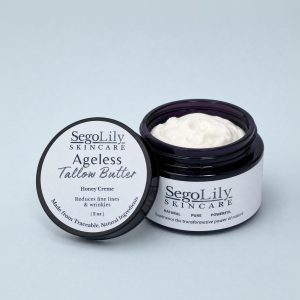
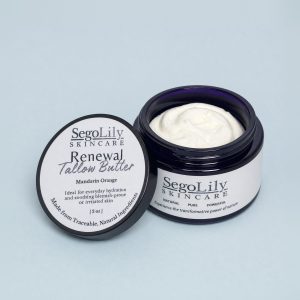
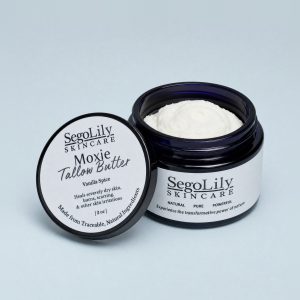
You can see what I make if you want to try it, and the ranch story is there if you would rather know where the fat comes from first.
Not sure which one suits your skin?
Answer a few questions and I'll point you at the jar that suits your skin.