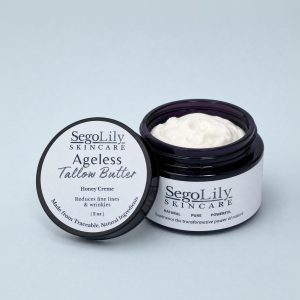
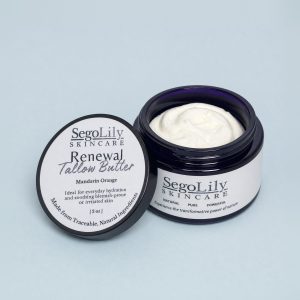
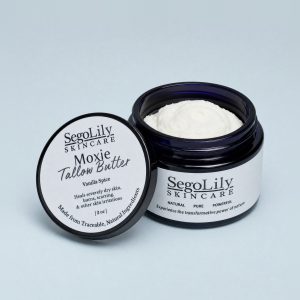
I sell one of these three, so read this knowing that. I’ve watched all three on real faces, and they don’t all do the same job.
Grass fed tallow vs shea butter vs coconut oil is really a question about what your skin is short of. The three aren’t short of the same things.
What Is Tallow, Shea Butter and Coconut Oil?
Shea butter is pressed from the nut of the shea tree, mostly across West Africa. It’s solid at room temperature, high in oleic and stearic acid. It carries a faint nutty smell that some people love and some people can’t get past.
Coconut oil is pressed from coconut flesh. It melts at about body temperature, which is why it feels like it disappears, and it’s very high in lauric acid.
Tallow is rendered beef fat. Mine comes from cattle finished on grass, rendered from kidney suet rather than trim. That’s the part that decides whether it smells like a Sunday roast or like almost nothing.
Grass Fed Tallow vs Shea Butter vs Coconut Oil: The Difference That Matters
Every one of these three slows water leaving your skin. That’s the job, and all three do it.
| Criterion | Grass-fed tallow | Shea butter | Coconut oil |
|---|---|---|---|
| Main fatty acids | Oleic, palmitic and stearic | Oleic and stearic | Lauric, roughly half |
| Melt point | About 95°F | Solid at room temperature | About body temperature |
| Rough pore rating | Low | Low | High, around 4 out of 5 |
| Smell | Almost nothing, when it's kidney suet | Faint and nutty | Coconut |
| Shelf life | Mine: 12 months sealed, 6 open | A year or two | About two years unopened |
Where they differ is how close they are to what your skin already makes. Human sebum is largely oleic, palmitic and stearic acid. Tallow’s fatty acid profile sits close to that, which is why it tends to go on feeling familiar rather than feeling like a layer.
I want to be careful with that claim, because it gets overstated constantly in my industry, mine included in the past. Sebum isn’t simply a fat. Alongside triglycerides it carries wax esters and squalene, and it contains sapienic acid, which is peculiar to human sebum and appears in no tallow anywhere. So the fatty acids overlap. The whole substance doesn’t, and anybody telling you tallow is identical to your skin’s own oil is selling harder than the evidence allows.
Shea is also oleic and stearic heavy, so it behaves similarly. Honestly the gap between shea and tallow is smaller than anybody selling either will tell you.
Coconut oil is the outlier. Lauric acid barely appears in human sebum, and coconut oil is roughly half of it.

Is Coconut Oil Comedogenic?
Yes, for a lot of people, and this is the one place I’ll be blunt.
Comedogenic means a substance tends to block pores. Coconut oil rates high on the commonly used scale, around a four out of five. Shea sits low, and tallow sits low, though I’d rather you treated all of these numbers as a rough guide than as physics.
The scale itself deserves a caveat. Much of it comes from old testing on rabbit ears rather than human faces. Reviewers looking back at that model found no reliable correlation with what actually happens on human skin. The rabbit reacts more readily than we do. Plenty of people use coconut oil on their face for years with no trouble at all.
A rating is a starting point, not a verdict
Comedogenic ratings are a rough guide built on limited testing. Your skin is the real test. Patch test on your forearm for several days before anything goes near your face, whichever of the three you try.
But if you break out easily and you’re using coconut oil on your face, it’s the first thing I’d change. It costs you nothing to find out.
Which Is the Best Natural Moisturizer for Dry Skin?
For genuinely dry skin, tallow or shea, and I wouldn’t fight hard for either over the other.
Coconut oil is the one I’d move away from here, for a reason that surprises people. It absorbs fast and feels lovely for about an hour, and for very dry skin that speed is the problem rather than the benefit. You want something that sits there and slows the loss, not something that vanishes.
Between tallow and shea it comes down to texture and smell more than performance. Shea is grainier and can feel waxy if it isn’t whipped properly. Tallow is denser and a little goes further than people expect, which is the most common mistake I see with mine.
Which One Goes Rancid First?
All three are fats, so none of them spoil the way a water-based cream does. What they do is oxidize, and they do it at different speeds.
Coconut oil is the most stable of the three by a wide margin. It’s highly saturated, which is exactly why it resists going off, and an unopened jar will sit in a cupboard for two years without complaint.
Shea is next, comfortably a year or two, though it can develop a grainy texture if it warms and cools repeatedly. That’s a texture change rather than spoilage, and whipping it back together fixes it.
Mine keeps 12 months sealed and 6 once it’s open, and the things that shorten it are light, heat and air rather than time on its own. A cupboard rather than a sunny windowsill buys you most of that back, and the violet glass I use is there for the same reason.
You will know when any of them turns. Rancid fat smells like old cooking oil and it’s unmistakable once you’ve met it.
Can You Use More Than One?
Yes, and plenty of people do without thinking of it as a routine.
The usual pattern is a lighter product first while skin is still damp, then a dense fat over the top. That second layer slows the water leaving. Layering a fat under a water-based lotion is the wrong way round, because you’ve put the barrier on before the water.
What I wouldn’t do is start all three at once. If you change three things and your skin improves, you’ve learned nothing about which one to keep buying. If it gets worse you’ve learned even less.
What About Sourcing?
Worth thinking about, and I won’t pretend my answer is clean.
Shea is largely harvested and processed by women’s cooperatives in West Africa, and buying it well can be genuinely good for those communities. Buying it badly is a different story, and the label rarely tells you which one you’ve got.
Coconut has a real land-use footprint in places that can’t afford one, and demand has grown fast enough to matter.
Tallow is a byproduct of an animal raised for meat. The fat exists whether or not anybody makes skincare from it, and for a long time most of it was discarded. That’s the honest case for it, and it depends entirely on how the animal was raised. Mine comes from cattle finished on grass on soil I can point at.
Which One Should You Choose?
- Choose coconut oil if your skin isn’t acne prone, you like a light finish, and you want something inexpensive that works on hair and body as well as face.
- Choose shea butter if you want a plant-based option that behaves much like tallow, and you’re happy to shop carefully on sourcing.
- Choose tallow if your skin is dry and stays dry, or you’ve tried plant butters and found they never quite hold, and the animal origin doesn’t bother you.
- Try a small area first if your skin runs oily. Plenty of oily skin was dry underneath the whole time, and everyone’s skin is different.
The Gap That Actually Matters
There’s no single best one. They’re three different fats and skin isn’t uniform. Any comparison that ends with the writer’s own product winning cleanly should make you suspicious, including this one.
What I’ll say is that in grass fed tallow vs shea butter vs coconut oil, the gap between the three is smaller than the marketing suggests. The gap between a well-made version and a badly made one is much larger. A carelessly rendered tallow is worse than good shea. Rancid coconut oil is worse than both.
That’s also why the shea butter vs tallow argument rarely settles anything. If it’s the tallow side you want to dig into, not all grass-fed tallow is created equal is where the quality gap actually lives. Both are dense, both behave well on dry skin, and which one suits you is a question your own face answers in two weeks.
Is beef tallow good for your skin makes the fuller case for the tallow column. You can see what I make if you want to try mine. Or read how it’s made first if sourcing is the question you care about.
Not sure which suits your skin?
Answer a few questions and I'll point you at the jar that suits your skin.