If you’ve decided to try tallow on your skin, the next question is which one. Every jar online says grass fed, and they aren’t all the same.
I’m a fourth-generation Montana rancher and I render my own, so here’s what I check before I’d put a tallow on my face, and how my own jars answer each one. If you’re still working out what the label words mean, start with what grass fed beef tallow is.
How Do You Choose a Grass-Fed Tallow for Skin?
Here’s how to check each one on any jar, and how mine answers it.

The Label Words, Briefly
Grass fed, grass finished and suet each mean something specific, and the difference shows up in the fat. I’ve gone through each one, and why the finish matters most, in the post on grass-fed beef tallow.
How to Check a Tallow Before You Buy It
A label can say almost anything. These are the places I look, and the questions I’d send a brand before I bought.
1. Grass finished, not only grass fed
Look for the word finished, on the jar or on the brand’s site. Nearly all cattle start on grass, so grass fed on its own can still mean an animal that spent its last months on grain. If the site doesn’t say, email and ask what the cattle ate at the end. A brand that knows will answer in a line. There’s more on what a grain finish does to the fat in what changes in the jar.
Mine: the cattle my suet comes from stay on grass their whole lives, finishing included.
2. Kidney suet, not trim
Look for the word suet. “Beef fat” or “tallow” on its own usually means trim, the cooking fat cut from the rest of the animal. Ask which fat it is. If they can’t tell you, assume trim.
Mine: kidney suet in every jar. I call it the extra virgin of tallow.
3. Who rendered it, and how
Ask whether they render it themselves or buy it already rendered. Then open the jar and smell it before the scent hits you. A beefy note underneath means it was rushed, or it’s trim.
Mine: I render it myself, low and slow, three times. That’s why it doesn’t smell like beef before any scent goes in.
On grass
The cattle move
They graze a stretch of soil down and then move on, so it rests and comes back deeper the next round.
Rendered slow
Low heat, small batches
I render it low and slow, three times, until it's clean and smells like almost nothing.
Into violet glass
Light kept out
Thick UV-protected violet glass, so it stays fresh on your shelf and not just in my kitchen.
Every jar of my grass fed tallow skincare starts in a ranch kitchen that still smells faintly of the last batch. It sits on a stretch of the Yellowstone Valley near Pompeys Pillar, where my family has run cattle for decades.
When the grass goes gold in late summer, I can almost guess how that season’s batch will come out. A shade deeper, a little richer in the jar.
No two batches come out identical, and I wouldn’t want them to. You can see the season in the tallow once you know what to look for.

4. A short ingredient list and no water
Read the ingredient list. If water or aqua is on it, there’s a preservative system too, because anything with water in it needs one. You should be able to name everything else.
Mine: no water, so no preservative system. It’s a short list, and I can name every one.
5. The glass
Look at the jar before you read the label. Clear glass or plastic lets light at the fat, and light breaks tallow down.
Mine: every jar is thick UV-protected violet glass. Most tallow brands reach for amber. Violet blocks more of the light that breaks tallow down over time, so week eight is as good as the day I poured it.
6. A seal you can check
The word organic in the copy isn’t the same as a certification. Look for the USDA organic seal on the product itself, and ask who certified it if you can’t find one.
Mine: Sego Lily is USDA certified organic, and the seal is on each product page. The deodorant is the one exception, and its certification is in progress. To my knowledge, I’m one of only three USDA organic tallow brands in the US.
7. A ranch they can name
“Montana” or “American” is a region, not a source. Ask which ranch. A brand with a real relationship will name it without thinking.
Mine: the B Bar Ranch in the Tom Miner Basin, USDA certified organic since 1993. I chose it on purpose, and I’m glad to name it.
What Should You Expect on Your Skin?
I’ll only promise on the part you can actually feel.
A clean, grass-raised tallow has some of the same fatty acids as your skin’s own oil. It doesn’t need a long list of synthetics propping it up to stay usable on a shelf.
It won’t erase years and it won’t do a procedure’s job. I’d tell you that plainly either way.
What it does is go on gently, on skin that’s been through too much. That’s most of the skin I make this for.
You can't add a good life back later
A jar of tallow is rendered fat and a little patience, the same thing a ranch wife would have recognized a hundred years ago. What separates a good one from a forgettable one is whether the animal lived well on real grass. You can’t add that back later, so I start there.
Tallow Skincare FAQ: Smell, Pores, and Violet Glass
By the time most people find me, they’ve been down the tallow rabbit hole online. These are the questions I hear most.
Does it smell like beef?
No. I render mine low and slow, three times, so the beefy smell is gone before any scent goes in. Then a plant-based fragrance carries whatever scent there is. If a tallow smells like a kitchen, it was rushed.
Will it sit greasy or clog my pores?
A little goes a long way, and most skin takes it in within a few minutes. Start with a small amount and let your own skin set the pace. I put mine on in the morning, but there’s no right or wrong time.
Why violet glass instead of amber?
Violet glass blocks more of the light that breaks tallow down over time than the amber jars most brands use, so the jar is protecting the freshness you paid for.
What is kidney suet?
The hard fat from around the kidneys, and the most nutrient-dense fat on the animal. I call it the extra virgin of tallow, and it’s what I use in everything I make.
How to Start Using Tallow Skincare
Start with one staple jar and let your own skin be the judge over a few weeks.
A 2 oz jar used daily on a face lasts two to three months. That makes it a low-stakes way to find out whether grass-fed tallow skincare is worth the difference to you.
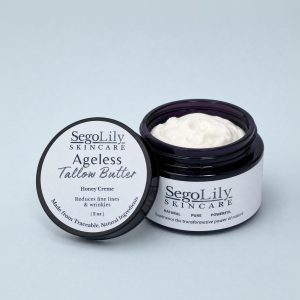
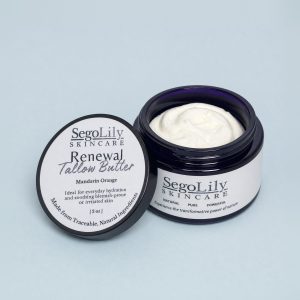
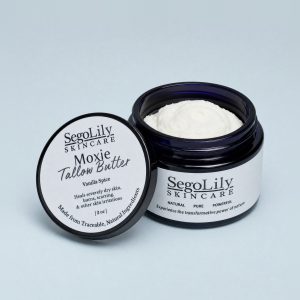
If your concern is aging skin, Ageless is the one I hand people first, in Citrus Breeze, Rosewood Lavender, Honey Creme or Mango. If your skin is easily annoyed, Renewal is the quieter line, in Mandarin Orange or Unscented. For skin that’s very dry or cracked, Moxie is the richest thing I make. You can see the whole line and pick the one that matches the skin you actually have.
Want me to pick for you?
Tell me about your skin and I'll point you at the jar that suits it.