I used to have a bathroom drawer I couldn’t shut.
Eleven things in it, and I couldn’t have told you what four of them were for. Buying better versions of the eleven wouldn’t have helped. What helped was minimalist skincare, which is a grand name for working out how few jobs my skin actually needed doing.
How Routines Get Long Without Anyone Deciding
Nobody sits down and plans an eleven step routine.
It accumulates instead. Something’s not working so you add a product, a friend recommends what fixed her skin, an ad catches you at the end of a long week. Every addition makes sense on its own. None of them tells you to take something away.
Then your skin gets touchy and you can’t tell which of the eleven did it. That’s the real cost, and it has nothing to do with product quality.
The test that shows you the problem
Count what you put on your face this morning. Then name what each one is for, out loud. The ones you can’t answer for are the ones to look at first.
What Are the Extra Steps Actually Doing?
Most of a long routine is water, and water is fine. It just isn’t what you think you’re buying.
A toner is mostly water, and so is an essence. A serum is water carrying a small amount of an active, and a light lotion is water held with a little oil. Layer four of those and you’ve hydrated once, four times over.
The last step does the different job. It keeps all that water from evaporating off, which is what a moisturizer is for. It’s also the step people skimp on, because it’s the least exciting thing to buy.
Why Skinimalism Suits Some Skin
Two honest limits before I go further.
If you’re treating something specific, shorter isn’t automatically better. A dermatologist who prescribed a treatment had a reason for the order. Cutting back around a prescription is a conversation for them.
Sunscreen also stays. It does a job nothing else on your shelf can do, and the American Academy of Dermatology is worth reading before you drop it. Simplifying past it costs more than the drawer space is worth.

Minimalist skincare earns its keep on skin that’s reacting to something unknown. If you’re not sure which jar fits your skin, the routine quiz narrows it down. Fewer inputs means you can find the culprit. With eleven products, you never will.
What a Short Routine Costs
The money argument is the one nobody makes honestly, so here it is with numbers.
A drugstore routine of six products at roughly fifteen dollars each runs ninety dollars, and most of those get replaced every two or three months. That’s somewhere near four hundred dollars a year, for products that are largely water by volume.
Two products at forty dollars is eighty dollars. A jar of tallow lasts two to three months on a face because you use a pea-sized amount. Call it three hundred a year. The per-jar price looks worse on the shelf and the annual number usually looks better, which is the opposite of how skincare is normally sold to you.
I’m not going to pretend that’s the whole story. Some cheap products are excellent and some expensive ones are water in nice glass. The point is that counting per jar tells you almost nothing, and counting per year tells you most of what you need.
What About Oily Skin?
There’s a fallacy that putting oil on oily skin makes it worse, and it doesn’t work that way. Plenty of oily skin was dry underneath the whole time, and it settles down once it stops overcompensating.
Everybody’s skin is different, so try it on a small area first, especially on your face, and give it a couple of weeks. If your face decides against it, that same jar works beautifully on heels, hands, elbows and neck, so you’re not out anything.
What I’d avoid either way is adding a seventh product to fix what the previous six did. That’s the loop this whole post is about, and it runs the same on oily skin as on dry.
How I’d Cut Back Without a Bad Month
Slowly, and not in the order you’d expect.
Take away one product a week. Give it seven days before judging. Skin turns over on its own schedule, so a two-day verdict is mostly noise. Start with whatever you couldn’t name a purpose for.
Keep your cleanser, moisturizer and sunscreen throughout. Those three are the frame. Everything else is a guest, and you’re finding out which ones earn the room.
If something goes wrong when you pull a product, you’ve learned what it was doing. That’s worth more than a smooth month of not knowing.
The part where I'm selling you something
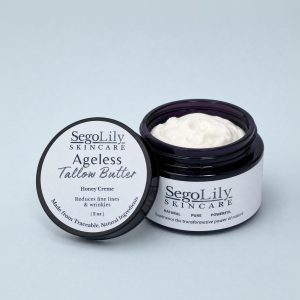
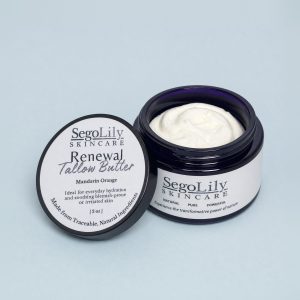
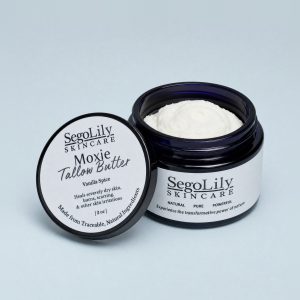
Tallow suits this approach because one fat does several jobs at once, so it replaces layers instead of joining them. Ageless handles most faces, Renewal is the quieter one for skin that’s had enough, and Moxie is there for hands and heels that have gone past dry into cracked. Same fat underneath all three.
What Does Minimalist Skincare Look Like in Practice?
Mine is Ageless, the Mango one, in the morning and Renewal Unscented at night, over a plain cleanser, with sunscreen when I’m out on the place all day.
That’s it, and that is what minimalist skincare looks like on a real face. My skin’s better on those two than it was on the ten I used to buy. I’m one person and my skin isn’t yours, so take it as a data point. The principle underneath is what I’d defend: you can only judge a product when it isn’t competing with six others.
Where I’d Start Tomorrow
Minimalist skincare starts with an audit, not a purchase. Open the drawer and pick up each thing in it.
Anything you can’t name a purpose for goes in a box, not the bin. You might want it back. Give it a week. Most people find their skin unchanged and their mornings shorter, and a few find out what one product was quietly doing. Either result is worth having.
If you want to try minimalist skincare with one jar instead of a shelf, the full range is the same fat underneath, so pick on your skin and your nose. Give it a month of mornings before you judge it, the way I had to.
If you want to start somewhere
Ageless is the one I hand people first, in Citrus Breeze, Rosewood Lavender, Honey Creme or Mango. Renewal is the quieter one, in Mandarin Orange or Unscented. Same fat underneath, so pick on your nose as much as your skin.