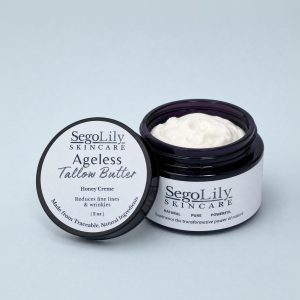
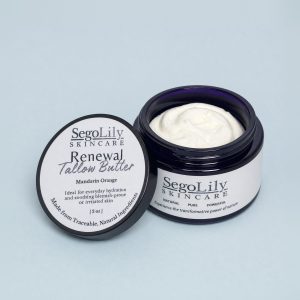
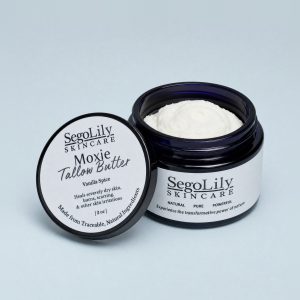
Nobody buying a jar of skincare expects a history lesson about cattle. But grain fed vs grass fed tallow is a question about what happened to this industry in one generation. The answer ends up in the jar either way.
I’m a rancher first, so this is the part I actually know something about.
What Changed After the War
Before the 1950s, cattle ate grass. Not as a philosophy, just because it was there and it was cheap. A cow walked around, ate what grew, and that was the whole system.
Then two things arrived at once. Grain got very cheap, and we got very good at growing it. And the industry worked out that an animal finished on grain reaches slaughter weight faster and fatter than one finished on grass.
Faster and fatter is a real advantage if you sell beef by the pound. Nobody was being sinister, it’s just what the incentives paid for.
What Is a Feedlot?
It’s where most cattle in this country spend the last few months of their lives.
A confined pen, hundreds or thousands of animals, and a ration built mostly of corn. The point is weight gain in the shortest possible window, and it works, which is why it’s the standard.
Here is the part I can’t be neutral about. A ruminant is built to eat grass. That’s what the whole animal is for, four stomach compartments and all, and it isn’t built to digest a heavy grain ration day after day. Doing it anyway is hard on them in ways anyone who has worked cattle can see.
I’m not going to pretend that’s a dispassionate view. It’s mine, and I’ve spent my life around these animals.
Why the price gap exists
Grass takes time. A grass finished animal needs months longer to reach the same weight, on land that could be running something else. That time is the cost, and it’s why grass finished beef and the fat that comes off it will always carry a higher price.
Grain Fed vs Grass Fed Tallow: Why the Diet Reaches Your Face
An animal’s fat is built out of what the animal ate. That’s just how bodies work.
Cattle finished on grass carry more of the fat-soluble vitamins, A, D, E and K, because those came from the plants. Change the diet to grain and the fat changes with it: more of it, faster, and a different composition.

So on grain fed vs grass fed tallow, the honest answer is that the raw material is genuinely different. What I won’t tell you is that your skin can feel the difference, because nobody has measured that and I’d be making it up.
Why Is Grass Fed Beef More Expensive?
Because you’re paying for time, and time is the one input nobody has found a way to compress.
There’s a second reason that gets less attention. Land that finishes cattle on grass has to be managed so the grass keeps coming back, which means moving animals, resting pastures. Accepting fewer head per acre than a feedlot runs in a single pen. That’s a smaller operation by design.
None of that makes it noble. It makes it slower and more expensive, and you’re entitled to decide that isn’t worth it to you.
Is Grain Finished Tallow Bad?
No, and I want to be careful here, because it would be easy for me to imply otherwise and it would sell more jars.
Grain finished tallow is still tallow. It’s still a dense fat, it still slows water leaving your skin, and it will still do that job on a dry face in February. If you’ve been using one and getting on well with it, nothing I’ve written is a reason to stop.
What’s different is the raw material, and the difference is real but narrower than the marketing on either side suggests. More of the fat-soluble vitamins in the grass finished version. A different fatty acid balance is the honest size of it.
The place where it stops being a fine distinction is the animal. A cow that spent its last months in a pen eating something it isn’t built to digest had a worse life than one that spent them on grass. That’s not a skincare argument and I won’t dress it up as one. It’s just the reason I make what I make.
Where Tallow Skincare Gets Its Fat
Most tallow skincare is made from fat somebody bought, already rendered, from wherever it was cheapest. That fat came off animals raised however the beef market wanted them raised, and the maker never asked, because the label doesn’t require them to.
Mine comes off cattle at the B Bar Ranch in the Tom Miner Basin, USDA certified organic since 1993, finished on grass and never in a feedlot. I know which animals, which soil and which season.
That’s a claim about the supply chain, which is the only part of this I can actually stand behind.
Is the Beef Industry Changing?
I get asked whether any of this is changing, and the honest answer is: slowly, and not for the reasons people assume.
It isn’t shifting because consumers demanded better fat for skincare. Skincare is a rounding error to the beef industry. What’s actually moving is a set of ranchers deciding that grazing this way holds their soil together through a dry year better than the alternative, which is an argument about staying in business rather than an argument about ethics. I’m one of them. We collared 210 head on our place this summer. Nobody up here did that for a skincare label.
That’s a sturdier reason than a trend, and it’s why I think it lasts. A practice that pays for itself on the land keeps going after the marketing moves on.
For a maker my size it means the supply exists at all. Twenty years ago sourcing grass finished suet from a named organic ranch would have been a much harder phone call than it is now.
What to Ask Before You Buy Tallow Skincare
You don’t need to become an expert on cattle to shop well. Ask what the animal was finished on, and ask the brand to name the ranch. If they can’t answer either, they bought commodity fat and never asked. The rest of what I check is in my checklist for choosing a grass-fed tallow.
Why I Bother With Any of This
I could buy rendered fat by the drum, and my margins would be considerably better than they are.
I don’t, because I know what the difference looks like from the ground up. Because how the animals are grazed changes the land they’re standing on. Mass-produced against small-batch is where that difference lands on your shelf. Healthy soil, healthy plants, healthy animals, healthy people. That’s the order, and you can’t join it halfway down.
You can see what I make from it whenever you like, and the ranch story is there if you want the longer version of where it starts.
Want to know what's in the jar?
The ranch story covers the cattle, the basin and how the fat gets from there to a shelf.