Everybody’s skin is different, and oily skin doesn’t automatically mean tallow won’t work for you.
I want to lead with that, because most of what’s written about tallow on oily skin sorts people into two buckets and sends half of them away. I’ve been doing this long enough to know that skin doesn’t cooperate with buckets.
What I’d tell you at my booth is what I’ll tell you here. Try it on one spot. Don’t commit your whole face to it on day one. And know that if your face says no, you haven’t wasted the jar.
Is Tallow Comedogenic?
The fair answer is that it depends on your skin, and I can’t see your skin from here.
Tallow is a rich fat. On skin that already makes plenty of its own oil, that’s more to ask than it is on skin that’s gone dry. Dermatologists quoted by Cleveland Clinic raise exactly this, and they’re right to raise it.
But “is tallow comedogenic” doesn’t have one answer for everybody. Comedogenic ratings come from patch tests that were never much good at predicting real faces. Plenty of people with oily skin get on with it. Plenty don’t. Neither group is wrong about their own experience, and neither group’s experience predicts yours.
If you want a number that decides this for you, I don’t have one, and anyone handing you one is guessing.
Does Tallow Clog Pores?
It can, on skin that congests easily. I’m not going to soften that, because you’d find out anyway and you’d rather hear it from me.
Here’s the part that’s more useful. When people ask does tallow clog pores, it’s usually because it already happened to them. And when I ask how much they were using, the answer is nearly always far too much.
It’s dense. The amount that works is much smaller than the amount that feels right in your hand. A thick layer of any rich fat on congestion-prone skin is going to cause trouble, and that’s a dosing problem rather than a verdict on the fat.
That doesn’t mean everyone who broke out used too much. Some skin just doesn’t get along with it, the same way some people can’t wear wool. But it does mean a fair test uses a lot less than you think.
Talk to whoever prescribed it before adding anything, including mine. Prescription routines are built carefully, and a rich fat dropped into the middle of one is a bad idea for reasons that have nothing to do with tallow.
How to Test Tallow on Oily Skin Properly
This is the whole point of the post, so here it is plainly.
- One spot, not your face. Pick somewhere you can watch. Along the jaw is the one I suggest most.
- Less than feels right. Pea-sized covers a whole face, so a test area needs barely anything at all.
- Two weeks, and actually look. Skin takes time to tell you things. Two days proves nothing either way.
- Change one thing. If you start this and a new cleanser in the same week, you’ll learn nothing about either.
If that patch looks busier than usual after two weeks, you have a real answer, and it cost you almost nothing to get it.

Will Tallow Make Me Break Out?
I can’t promise you either way, which is exactly why I’d rather you tested it cheaply than took my word for it.
What I can tell you is that the question “will tallow make me break out” gets answered far more often by a two-week patch than by any amount of reading. Your skin already knows. It just needs a fair chance to say so.
Tallow for Combination Skin
This is where most of the yes answers live, and it’s the group I’d most encourage to try.
Plenty of people are dry across the cheeks and oily through the middle. Tallow for combination skin often works well if you stop treating your face as one surface. Use it where you’re dry, leave it off where you aren’t, and don’t feel obliged to apply it evenly just because it came in one jar.
That’s not a clever trick. It’s what the people who get on with it have generally worked out for themselves.
If Your Face Says No, You Still Have a Jar
This is the part nobody tells you, and it’s the reason I don’t think trying tallow on oily skin is much of a risk.
If it turns out not to suit your face, the same jar still works beautifully everywhere else: heels, hands, elbows, knees, neck, and the backs of your arms in February.
Feet especially. Cracked heels are the thing tallow is almost unfairly good at, and plenty of people who decided against it for their face carry on buying it for their feet.
So the downside of testing isn’t a wasted jar. It’s a jar that ends up living somewhere other than your bathroom shelf.
The Two Weeks That Tell You
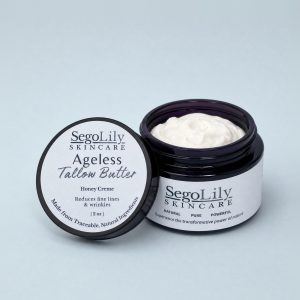
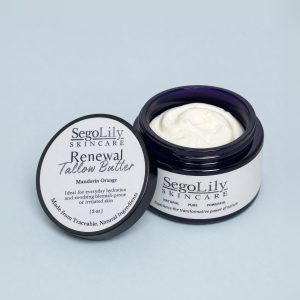
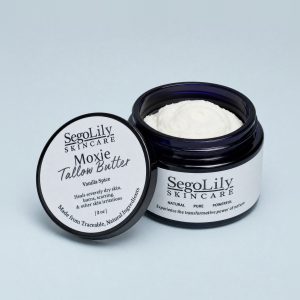
Renewal Unscented, if you’re going to try it. Not because it’s lighter, the formula is just as rich, but because it takes fragrance out of the picture so you’re testing one thing instead of two. Renewal is also the one I point sensitive and acne-prone skin toward generally.
Use less than you think, on part of your face, for two weeks.
That’s the whole method. Tallow on oily skin isn’t a yes or a no you can look up, it’s a small test you run on yourself, and either result is worth having. You can see the full range, and how it’s made is over at the ranch.
Try one spot before you commit
If it suits you it suits you, and one small jar tells you that faster than any review will.