Yes, it’s beef fat. You read the label right. If that gave you pause, you’re in good company, and the reason it works is the same reason it sounds strange.
Most people find me after a few weeks of seeing tallow everywhere. They want to know whether it’s a trend or something worth their money.
So, is beef tallow good for your skin? For dry or normal skin, usually yes. If your skin runs oily or reacts easily, it’s worth a spot test before you commit your whole face. I render mine in my own kitchen in Pompeys Pillar, Montana, and everybody’s skin is different. I’d rather you found out on a small patch than took my word for it either way.
Below I’ll walk you through what tallow actually is, what’s in the jar, why so much of it smells like dinner, and how to tell whether it suits your skin.
What Beef Tallow Actually Is
Tallow is rendered beef fat. Rendering means cooking raw fat low and slow until the pure fat separates out.
You strain it, let it set, and you’re left with a firm off-white fat. It stays stable at room temperature for a long time.
Not all beef fat is the same, and that’s where most brands lose me. There are two kinds worth knowing about.
Suet is the hard fat from around the kidneys. It is the most nutrient-dense fat on the animal. I call it the extra virgin of tallow.
Trim fat comes off the outside of the cuts. It’s cooking fat. It works fine in a pan and it carries a much stronger beefy smell.
I use kidney suet in everything I make. That one choice does more for the finished jar than anything else I do.
One question tells you which you're holding
Ask a brand whether their tallow is suet or trim, and whether they rendered it. The ones who did will answer in a sentence. The ones who bought it in will tell you about their values.
Is Beef Tallow Good for Your Skin? What It Does
Tallow has some of the same fatty acids as your skin’s own oil. It goes in rather than sitting on top like a film.
That’s a big part of why dry skin gets on so well with it.
I also micro-aerate mine, which changes how it goes on. People brace for a fat this dense to sit greasy on the skin, and the ones who write to me say it doesn’t.
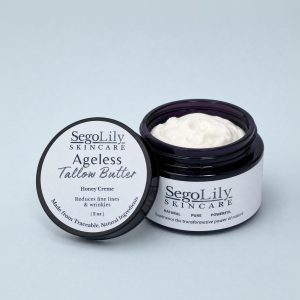
My jars are also simple. A jar of Ageless has a short list of ingredients, and I can name every one. If your skin’s been through a long stretch of complicated routines, simple usually helps more than another active.
Tallow is a cosmetic, though, and I want to be plain about that. It isn’t medicine, and it doesn’t act on a diagnosed skin condition. If a doctor has named something on your skin, tallow isn’t your answer, and anyone telling you different has stopped being straight with you.
What you can reasonably expect is skin that feels comfortable for longer. Less of that tight feeling twenty minutes after you wash your face. Fewer steps, because one dense fat usually covers what two thinner products were splitting.
Those are small wins. They’re also the ones customers still mention to me a year later. If you want to see what it looked like on one face over nine months, here’s my own beef tallow skin before and after.
What the research says
I’d rather tell you this myself than have you find it somewhere else.
There isn’t much research on tallow for skin. Dermatologists quoted by Cleveland Clinic and Scripps point that out, and they’re right to. On oily skin my own answer is to try a small area first, because everyone’s skin is different.
I’m not going to argue with any of that. Tallow is a rich fat, and micro-aeration is what keeps it from behaving like one. If yours runs oily, put a little on one spot and give it two weeks before you commit your whole face.
Thin research isn’t the same as evidence against it. Nobody has funded a trial on rendered beef fat, and there’s no patent waiting at the end of one.
What exists instead is a long history of people using it, plus a lot of customers telling me their skin feels calmer. That’s weaker than a trial. I’d rather hand you both halves and let you decide.
Tallow is also unregulated, so the gap between a careful maker and a careless one is wide and you can’t see it on the label. Suet or trim decides most of that gap, and cooking temperature decides the rest.
What Is in the Jar
Tallow carries things with it, and most of what it carries comes from the animal.
Most of the grass fed tallow benefits for skin start with what the cattle ate. Cattle finished on grass produce a different fat than cattle finished on grain.
You can see it before you smell it. Grass-fed tallow renders a deeper, warmer color, and it shifts a little season to season with how the grass came in.
I like that it shifts. A fat that comes out identical every single time has been processed a long way from where it started.
My batches vary too, mostly between fall and winter rendering. That’s not a defect, and it’s worth knowing before your second jar looks slightly different from your first. If you want to see where the fat comes from, it’s all at the ranch.
Does Tallow Smell Like Beef?
This is the complaint I hear most, and it’s fair. Someone tries a tallow product, it smells like a roast, and they write off the whole category.
Two things cause it, and both come down to who did the rendering.
Most tallow brands don’t render their own fat. They buy it already rendered, which means they didn’t choose between suet and trim, and they didn’t control the heat. Those two decisions set the smell.

I do mine from raw fat to sealed jar. Low heat, strain, chill overnight, then scrape the impurities off the bottom and do it again. Every batch gets three passes, low and slow.
The second cause is fragrance. Many brands cover the smell with something that sits on top of the fat without changing it. I use plant-based fragrance oil, which fuses into the fat instead of floating above it. Working that out took me months. I wrote about it in our story.
Does Tallow Clog Pores?
It can, on skin that already runs oily. This is the question I get asked most, usually phrased as: is tallow comedogenic?
The fair answer is that it depends on your skin, and I can’t see your skin from here. Everyone’s skin is different, and oily skin is where the answers split most. Plenty of oily skin turned out to be dry underneath the whole time.
If that describes you, start with a small amount at night and give it two weeks. If your skin looks busier than usual, stop. That’s real information and it’s worth more than my opinion.
If it doesn't suit your face
A small share of people simply don’t get on with tallow on their face, the same way some people can’t wear wool. If your skin looks busier after two weeks, take it off your face. You’re not out a jar, though, because the same tallow works beautifully on heels, hands, elbows and neck.
The full answer to does beef tallow clog pores, with what’s in each jar and why, is on my science page.
Where I’d Have You Check First
There are a couple of situations where I’d want you to talk to someone else before you start, or where a jar honestly isn’t going to be the thing you’re after.
- You’re being treated for a skin condition a doctor named. Tallow is a cosmetic and doesn’t belong in the middle of a treatment plan you didn’t clear with them.
- You avoid animal products. Mine is beef fat and there’s no version of it that works around that.
- You want something light and fast-absorbing. Even aerated, tallow takes a moment to settle and it isn’t a summer gel.
There is also the scent question. Mine is mild, but it isn’t nothing. If you’re sensitive to fragrance in general, start with Renewal Unscented.
One more practical thing: tallow melts at about 95 degrees, so a jar that was firm in spring can go nearly spreadable by midsummer. That’s normal and it reverses. You just need less of it than you think.
Is beef tallow good for your skin?
For dry or normal skin, usually yes. It has some of the same fatty acids as your skin’s own oil, and it goes in rather than sitting on top. If your skin runs oily, try it on one spot for two weeks before you commit your whole face.
Does tallow clog pores?
It can, on skin that runs oily or congests easily. Dermatologists raise this and they’re right to. Try a small amount at night for two weeks and watch what your skin does.
Does tallow smell like beef?
Cheap tallow does. Mine is mild because I use kidney suet rather than trim fat, and I render it three times myself instead of buying it already rendered.
How long does a jar last?
Two to three months for a 2 oz jar used daily on a face. Most people use far too much in the first week.
Why did my jar get soft?
Tallow melts at about 95 degrees. Warm-weather softening is normal and it reverses. It isn’t a sign anything is wrong with the batch.
Can I use it if I have eczema?
Talk to your dermatologist first. Tallow is a cosmetic, not a treatment, and it doesn’t belong in the middle of a plan you didn’t clear with them.
Where to Start If You Want to Try It
Start with one jar and one job. Use it on clean skin and give it a month. A 2 oz jar used daily on a face lasts two to three months, so one jar covers it.
Don’t change three things at once. If you swap your cleanser, add tallow, and start a serum in the same week, you won’t know what did what.
I make six things and I reach for different ones as the seasons turn. What I care about is that you know what each one does before you pick.
Whichever you start with, give it a small area and two weeks. Your skin answers faster than you’d think.
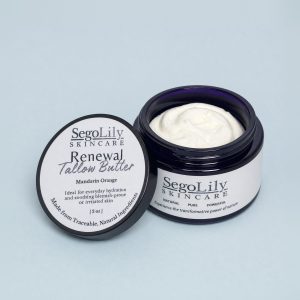
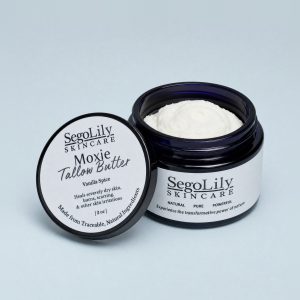
Most people start with Ageless. It comes in four scents on one formula, so the choice is only about what you like the smell of. It’s the one I hand people first. I’m a Mango girl myself. If your skin is easily annoyed, Renewal is the quieter line, in mandarin orange or unscented. If you’re pregnant or shopping for a new baby, Baby & Mom is that same unscented formula under a label made for it. Moxie is there once skin has gone past dry into cracked. They all live in the shop, and you’re welcome to email me before you buy anything.
Not sure which one is yours?
Answer a few questions about your skin and I'll point you at the right jar for it.