You’ve probably seen someone online swear off seed oils entirely. Then seen a skincare brand put “seed oil free” on a label like it settles something.
I render tallow for a living, so people assume I’m about to agree. I’m not, entirely. Are seed oils bad for your skin is a fair question with an uncomfortable answer. The loudest version of the argument is about eating them. It got carried over to your face without anybody checking whether it still applied.
Here is what the panic gets right, what it gets wrong, and what I actually use.
Where the Seed Oil Argument Came From
The original fight is a nutrition fight. It’s about a fat high in omega-6 linoleic acid, heated and eaten in large amounts. Over years it displaces other fats in your diet.
You can find serious people on both sides of that. What you can’t do is pick it up whole and drop it onto a moisturizer, because almost none of the mechanism survives the move. Nothing you put on your cheek is being heated to a frying temperature, metabolized, or eaten in quantity across a decade.
The line that keeps getting crossed
Eating a fat and applying a fat are different questions with different evidence. A claim that’s arguable at the dinner table isn’t automatically true on your face. Most of the seed oil panic in skincare is that swap, made silently.
So Are Seed Oils Bad for Your Skin, Really?
Mostly no. What matters more is which oil, how fresh it’s, and what your skin is actually short of.
The useful distinction is linoleic acid against oleic acid. Skin that’s oily or acne-prone tends to be low in linoleic acid. The research that exists suggests those people usually do better with a higher-linoleic oil. That is what most seed oils are. Skin that’s dry or mature usually wants the richer, more occlusive oleic side, which is where tallow sits.
So the same oil can be a good idea on one face and a poor one on another. That’s a duller answer than “seed oils are toxic”, and it’s closer to true.
What Actually Goes Wrong With Seed Oils in Skincare
There’s a real problem in here, and the panic is pointing near it without naming it properly.
Oils high in polyunsaturated fat oxidize faster. Think of a cheap seed oil, pressed with heat, sat in a clear bottle on a warm shelf for a year. By the time you get to it, it isn’t doing your skin any favors. That’s a freshness and handling problem, not a category problem. So the answer is about sourcing rather than banning a whole class of ingredient.
The other real problem is quantity. When a cheap oil is most of the jar, the interesting ingredients are a rounding error at the bottom of the label. You’re mostly paying for the cheap oil. Again, that’s a formulation complaint, not a chemistry one.
What I Use, and Why I Am Not Claiming Seed Oil Free
I use some. Hibiscus is a seed oil and it is in the jar, in a small amount, for the appearance of elasticity alongside the argan. It also carries the plant-based fragrance without the alcohol burn-off that leaves a meaty note behind.
I could leave that out of this post and let you assume otherwise. Plenty of brands would, because “seed oil free” is selling well right now. But it would be a lie. The whole reason anybody trusts a small maker is that she tells you what’s in the jar. Even when the trend would reward her for staying quiet.
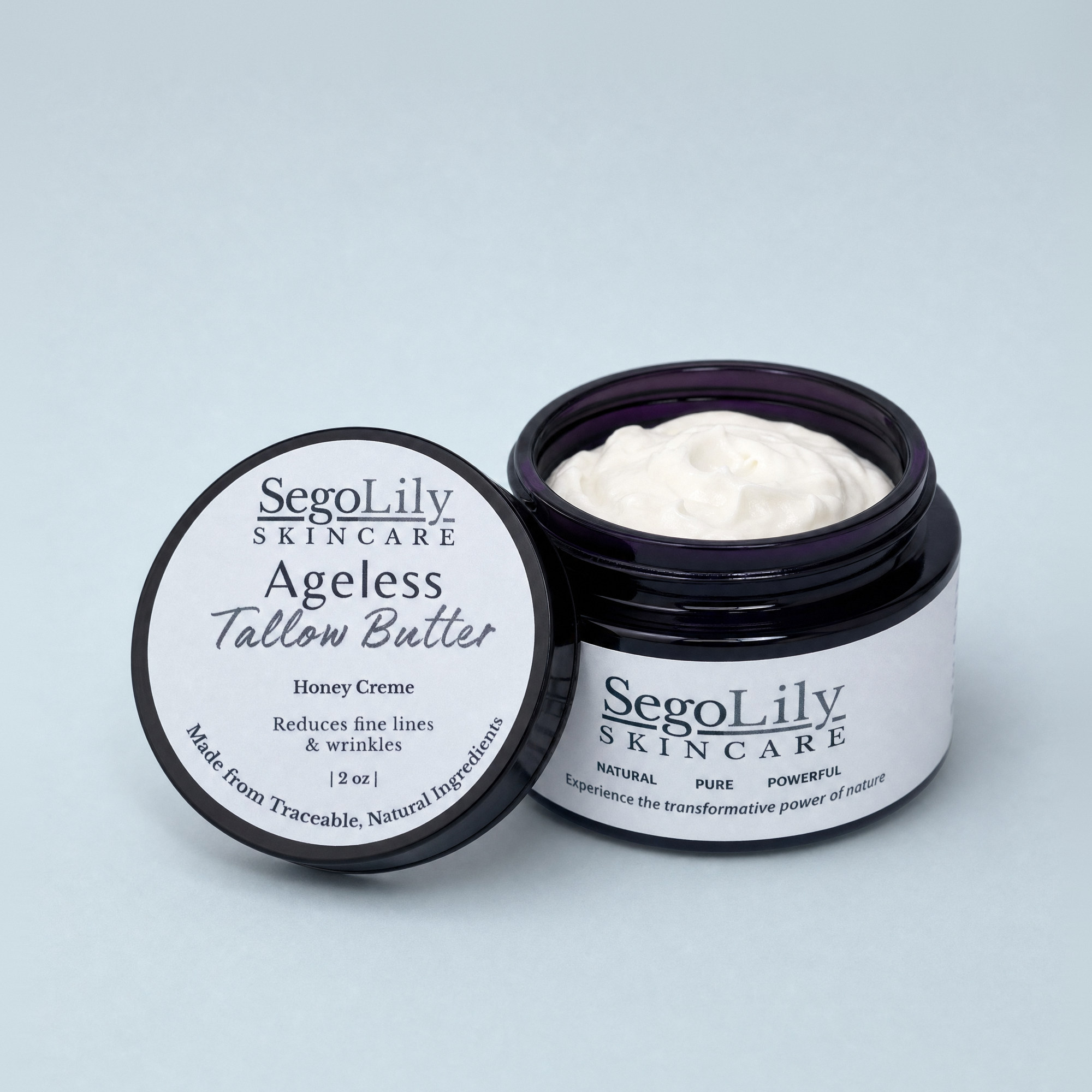
The base is rendered tallow from cattle raised on grass. The seed oils are carriers, they’re fresh, and they’re a small part of a formula built around a fat that’s mostly oleic. That’s the honest version.

How Should You Choose, Then?
Work backwards from your own skin instead of from a headline. If you’d rather start from your skin than from a list of oils, the routine quiz does that.
If your skin is oily or breaks out, a higher-linoleic oil is more likely to help than harm. Cutting all seed oils on principle may remove the thing you were short of.
If your skin is dry, mature or wind-beaten, you want the richer oleic fats, and tallow is a straightforward way to get them. That’s a fit argument, not a purity argument.
Either way, judge freshness over ideology. Small batches, opaque or violet glass, a maker who will tell you when it was made. An oxidized premium oil is worse for you than a fresh cheap one, and no ingredient list on earth shows you that.
If you want to read past the marketing on either side, the underlying skin-lipid research is there to read.
If You Want the Simple Version
Seed oils aren’t poison and tallow isn’t magic. Your skin has a lipid profile and so do oils. The useful question is whether the two match. Then whether what you bought is fresh enough to still be what it says.
If dry, mature or reactive skin is what you’re working with, a mostly-oleic fat like tallow genuinely earns its place. You can see what I make whenever you want to try it.
Read the short list yourself
Every jar is tallow, and the ingredient list is short enough to read in the shop. That holds for all six of them.